





































































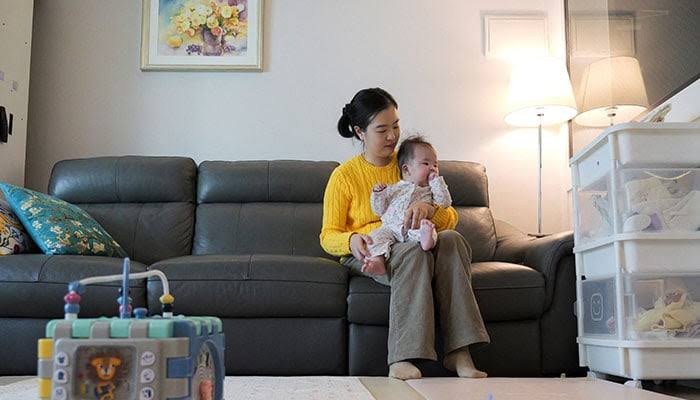
SEOUL, (Reuters): South Korea’s birthrate rose for the second consecutive year in 2025, according to new government data released Wednesday, raising cautious optimism that the country may be beginning to reverse nearly a decade of demographic decline.

The total fertility rate — the average number of children a woman is expected to have during her lifetime — climbed to 0.80 in 2025, up from 0.75 in 2024, preliminary figures from the Ministry of Data and Statistics showed. The rebound follows a historic low of 0.72 in 2023, the lowest national birthrate ever recorded globally.
New births had already begun to recover in 2024, driven by post-pandemic effects and expanded government support measures, after eight straight years of decline. In 2025, there were 5.0 births per 1,000 people, up from 4.7 in 2024. By comparison, China recorded 5.6 births per 1,000 people last year, Japan 5.7 in 2024, and Taiwan 4.6.
The pace of improvement exceeded the government’s most optimistic projection, which had forecast a fertility rate of 0.75 in 2025 and 0.80 in 2026. Authorities now anticipate the rate could surpass 1.0 by 2031 if the upward trend continues. A key factor behind the rise has been a steady increase in marriages — typically considered a leading indicator for births with a one- to two-year lag.
Marriages increased 8.1% in 2025, following a record 14.8% jump in 2024.“The biggest part is that marriages are increasing significantly, accumulatively,” said Park Hyun-jung, a ministry official, noting demographic shifts such as a larger population in their 30s and evolving social attitudes toward marriage and family life.Seoul recorded the sharpest growth in new births, with the capital’s fertility rate rising 8.9% to 0.63 from 0.58 in 2024. However, it remains the lowest rate nationwide.
Experts caution that some of the rebound may reflect statistical factors, including changes in population composition. Shin Kyung-ah, a sociology professor at Hallym University, said the data requires careful scrutiny but described it as a meaningful sign. She added that it suggests positive changes that could indirectly encourage more people to think positively about having children.
Public attitudes toward marriage also appear to be improving. A 2024 biennial government survey found that 52.5% of South Koreans held positive views on marriage, up from 50.1% in 2022. Respondents said they ideally wanted an average of 1.89 children.
In total, new births rose 6.8% in 2025 to 254,457 — the largest percentage increase since 2007. However, deaths also climbed 1.3% to 363,389, marking the sixth consecutive year of natural population decline. Despite the rebound, South Korea faces mounting economic challenges from its rapidly ageing population.
President Lee Jae Myung’s administration plans to introduce a five-year demographic policy roadmap later this year aimed at strengthening support for young adults, low-income earners and the unemployed. The government also intends to expand childbirth incentives and consider measures to attract skilled foreign workers to offset a shrinking labour force.
South Korea’s potential economic growth rate — currently estimated at around 2% annually — has fallen by six percentage points over the past three decades, more sharply than in most major economies. The central bank projects growth could slow further to 0.6% between 2045 and 2049.
Credit rating agencies have warned of increasing pressure on public finances due to rising welfare costs. The country’s $1 trillion public pension fund, the world’s third-largest, is projected to be depleted by 2071 without reforms.South Korea’s population of 51.8 million is expected to shrink to 36.2 million by 2072, according to government projections released in 2022.
President Lee has called for greater regional cooperation to address demographic challenges and has proposed hosting the Asia-Pacific Economic Cooperation (APEC) group’s first population policy forum in South Korea this year. During visits to China and Japan in January, he also agreed with regional leaders to collaborate on tackling ageing population issues.