














































ISLAMABAD: Pakistan and Australia have discussed the possibility of signing an Intergovernmental Agreement (IGA) to establish structured and long-term cooperation in Pakistan’s mining and mineral sector.

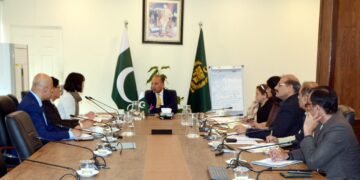
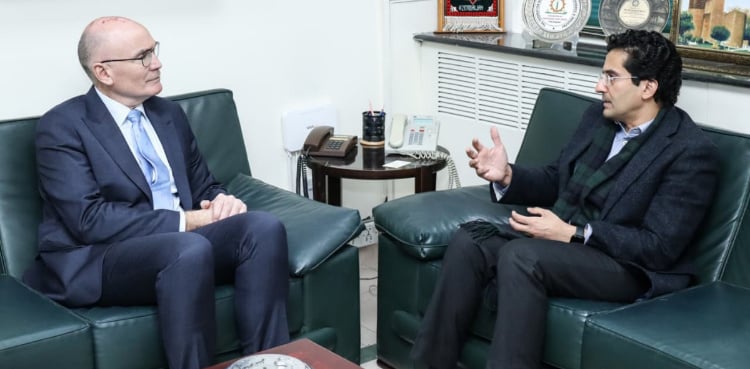
The proposal was put forward by Federal Minister for Petroleum Ali Pervaiz Malik during a meeting with Australia’s newly appointed High Commissioner to Pakistan, Timothy Kane.
The proposed agreement aims to strengthen bilateral collaboration and attract sustained Australian investment and expertise into Pakistan’s largely untapped mineral sector.
The initiative builds on a July 2025 proposal by former Australian High Commissioner Neil Hawkins, which focused on collaboration between Australian universities, mining companies, and Pakistani institutions to develop specialised training programmes in modern mining techniques and services.
According to an official statement, both sides discussed expanding cooperation in the mining and gemstone sectors. The petroleum minister highlighted Pakistan’s vast mineral potential, particularly in the Tethyan Belt, and welcomed the growing interest of Australian companies in exploration and development projects.
Australia has been active in Pakistan’s mineral and natural resources sector for decades, particularly in resource-rich regions such as Balochistan, Gilgit-Baltistan and Azad Jammu and Kashmir.
Australian firms have played a key role in research and exploration, identifying significant reserves of copper, gold, coal, zinc, oil and gas. One of the most prominent outcomes of this cooperation was the discovery of the Reko Diq copper-gold deposits through a joint venture between Australia’s BHP Billiton and the Geological Survey of Pakistan. Although BHP later exited Pakistan as part of a global restructuring, the project is now being developed by Canada’s Barrick Gold Corporation.
Mr Malik also briefed the Australian envoy on the government’s efforts to formalise and develop the gemstones sector to enhance value addition, exports and employment generation.
High Commissioner Kane noted that Australian companies were already involved in the Reko Diq project and said more firms had expressed interest in participating. He encouraged Australian companies to attend the Pakistan Minerals Investment Forum (PMIF), expressing hope for a strong Australian presence.
Highlighting the growing global demand for copper and gold due to the energy transition, the envoy said Pakistan’s mining sector had gained significant international attention. He expressed optimism about cooperation in the gemstones sector through knowledge sharing, training and technical assistance.
The two sides also reviewed the petroleum minister’s recent visit to Australia for the International Mining and Resources Conference (IMARC), where discussions were held with major and junior Australian mining companies on investment opportunities in Pakistan.
The presence of minerals at Reko Diq was first identified in the early 1990s by the Geological Survey of Pakistan in collaboration with BHP. In 2000, Australia’s Tethyan Copper Company (TCC) took over the project and invested $30 million in exploration, drilling more than 75,000 metres to confirm reserves.
TCC was later acquired by Antofagasta of Chile and Barrick Gold Corporation of Canada. However, disputes during the Musharraf-era agreement led to international arbitration and a prolonged delay in the project’s development.
Initial estimates put Reko Diq’s reserves at two billion tonnes of copper and 20 million ounces of gold, valued at $65 billion at the time of discovery. Recent feasibility studies by Barrick confirm the project’s strong commercial viability, with an expected annual throughput of 45 million tonnes in Phase 1 from 2028, doubling to 90 million tonnes in Phase 2 by 2034.
Over the mine’s life, production is projected at 13.1 million tonnes of copper and 17.9 million ounces of gold on a 100 per cent basis. The updated feasibility study estimates a robust 25 per cent rate of return, making Reko Diq one of the world’s largest and most lucrative copper-gold projects.