






















































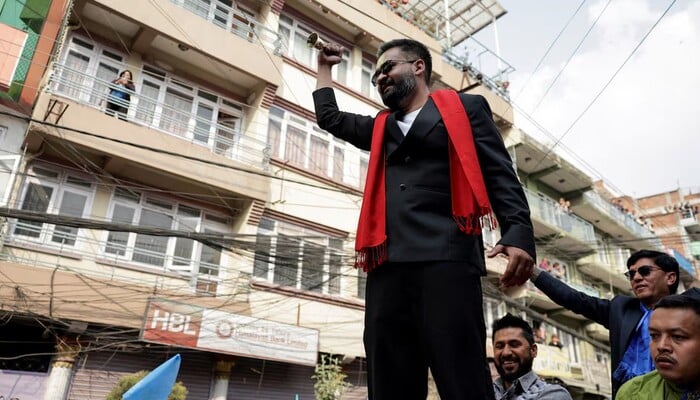
KATHMANDU: Balendra Shah, a rapper-turned-politician and former mayor of Kathmandu, is on course to become Nepal’s next prime minister as early vote counting shows his party taking a commanding lead in the country’s general election. Shah, widely known as Balen, is the prime ministerial candidate of the Rastriya Swatantra Party (RSP), which is currently leading in around 100 constituencies, far ahead of rival parties, according to early trends released by the Election Commission.

The election marks Nepal’s first national vote since a youth-led uprising in September that left 77 people dead and forced then-prime minister KP Sharma Oli to resign. Shortly after Oli stepped down, the 35-year-old Shah addressed his millions of social media followers with a message aimed at the younger generation.“Dear Gen Z, the resignation of your killer has come,” Shah wrote. “Now your generation will have to lead the country. Be prepared.”Five months later, Shah appears set to lead the government following the March 5 election.
Final results from 165 directly elected seats and 110 proportional representation seats are expected within the next few days. The Nepali Congress, currently trailing in second place, has already conceded defeat, and analysts say the RSP is likely to form the next government.If confirmed, Shah’s rise would represent a major shift in Nepal’s political landscape, which has long been dominated by a handful of traditional parties.
Political analyst Bipin Adhikari said Shah’s popularity has reached remarkable levels.“Balen Shah is so popular that buses coming to Kathmandu have stickers saying ‘Headed to Balen’s city’,” said Adhikari, a constitutional law expert at Kathmandu University. Shah first gained political prominence in 2022 when he was elected mayor of Kathmandu.
During his tenure, he focused on improving urban infrastructure, including waste management, and expanding public services such as healthcare. However, his administration also faced criticism. Rights groups, including Human Rights Watch, accused authorities of using police to confiscate property from street vendors and landless residents.
Shah resigned as mayor in January to contest the general election. Unlike many of Nepal’s veteran politicians, Shah has largely avoided mainstream media, instead communicating directly with the public through social media platforms where he has more than 3.5 million followers.
Independent political analyst Puranjan Acharya said Shah’s strong connection with young voters has been key to his popularity, but warned governing the country will be a far greater challenge.“What makes Balen special is his direct connection with the youth through short messages on social media,” Acharya said. “But becoming prime minister will not be a cakewalk.”Born to a father who practiced traditional Ayurvedic medicine and a homemaker mother, Shah developed an early interest in poetry before turning to rap music. His musical style was influenced by American artists including Tupac Shakur and Curtis Jackson.
He later earned a civil engineering degree in Nepal before pursuing a master’s degree in structural engineering in southern India, by which time he had already become a well-known rap artist.
Many of his songs criticize Nepal’s political establishment. One of his most popular tracks, “Balidan,” released in 2019, has gained more than 12 million views on YouTube.The song’s lyrics include a message of defiance against authority:“Let me speak, sir, it is not a crime… my mind is not afraid to speak the truth.”
In December, Shah joined the RSP led by former television host-turned-politician Rabi Lamichhane, who nominated him as the party’s prime ministerial candidate.
The party’s manifesto promises sweeping economic reforms, including creating 1.2 million jobs, reducing labour migration abroad and expanding social safety nets such as nationwide health insurance. It also aims to increase Nepal’s per-capita income from $1,447 to $3,000 and more than double the country’s economic output to a $100 billion GDP within five years.
Analysts say Shah’s success as prime minister will depend largely on the team of experts and administrators he assembles to tackle corruption and reform the country’s bureaucracy.“It needs a team, experts and support,” Acharya said. “Under the existing state apparatus, he cannot perform alone — otherwise he will be finished like wood attacked by termites.”