













































KATHMANDU: Five months after a youth-led uprising in Nepal left 77 people dead and forced then-Prime Minister K.P. Sharma Oli to resign, rapper-turned-politician Balendra Shah — popularly known as “Balen” — is now leading the race to become the country’s next prime minister.

In a message posted to millions of followers after Oli’s resignation last September, the 35-year-old wrote: “Dear Gen Z, the resignation of your killer has come. Now your generation will have to lead the country. Be prepared.”As Nepal heads toward general elections on March 5, Shah has emerged as the dominant contender. While Nepal lacks reliable opinion polls, several political analysts and local media outlets project him as the leading choice for prime minister, signaling a potential shift away from the country’s traditional political elite.
Shah’s meteoric rise represents a major challenge to Nepal’s long-established political parties, including Oli’s Communist Party of Nepal (Unified Marxist–Leninist), often viewed as leaning toward China, and the centrist Nepali Congress, considered closer to India. Shah’s Rastriya Swatantra Party (RSP), a relatively new centrist force, has pledged to maintain “balanced foreign relations” with both neighboring giants.“Balen Shah is so popular that buses coming to Kathmandu have stickers on them saying, ‘Headed to Balen’s city,’” said Bipin Adhikari, a constitutional law expert at Kathmandu University. If elected, Shah’s victory would mark a dramatic transformation in Nepal’s political landscape — a small Himalayan nation of 30 million people long dominated by established parties and veteran politicians.
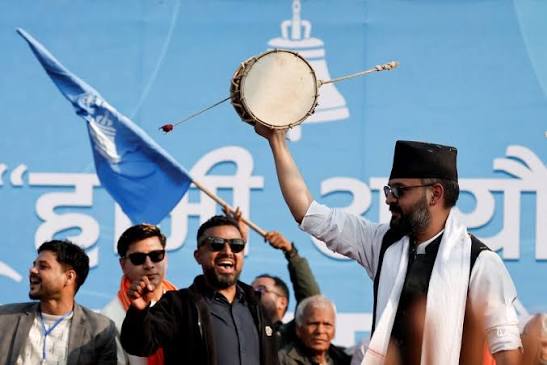
Unlike many of Nepal’s older political leaders, Shah has built his popularity largely through social media, where he commands more than 3.5 million followers on platforms such as Facebook. He has largely avoided mainstream media, preferring direct communication with supporters online.
His campaign posts often feature images of him on the trail in his trademark dark sunglasses and salt-and-pepper beard — a carefully cultivated persona that resonates strongly with young voters.“What makes Balen special is that he stays connected with the youth through his short messages on social media, but it will not be a cakewalk for him after becoming prime minister,” said independent political analyst Puranjan Acharya.
Born to a father who practiced traditional Ayurvedic medicine and a homemaker mother, Shah developed an early interest in poetry before turning to rap music. Influenced by American artists such as Tupac Shakur and Curtis “50 Cent” Jackson, he gained national fame for songs critical of Nepal’s political establishment.
His 2019 track “Balidan” (“Sacrifice”) has garnered more than 12 million views on YouTube. Its lyrics read: “Let me speak, sir, it is not a crime, let me open the mind, I am not a curse to the palace, my mind is not bad, it is not afraid to speak the truth.”Shah holds an undergraduate degree in civil engineering from Nepal and a master’s degree in structural engineering from southern India. By the time he completed his studies, he was already a well-known rap artist at home. He formally entered politics in 2022, contesting Kathmandu’s mayoral election as an independent under the slogan “Time for change,” and won by a wide margin.
As mayor, Shah focused on urban reforms, including waste management and improving public services such as healthcare. However, he also faced criticism from rights groups, including Human Rights Watch, for allegedly using police to confiscate property from street vendors and landless individuals. Shah resigned as mayor in January to contest the general election.
Last December, Shah joined the RSP, led by former television host-turned-politician Rabi Lamichhane, as its prime ministerial candidate.
The party’s manifesto includes ambitious goals: creating 1.2 million jobs, reducing forced migration, raising per capita income from $1,447 to $3,000, doubling the economy to a $100 billion GDP, and providing nationwide healthcare insurance — all within five years. These pledges aim to address widespread frustration in a country where roughly 20% of the population lives in poverty and millions seek employment abroad due to low wages and limited opportunities at home.
Analysts caution, however, that governing Nepal will require more than popularity. “It needs a team, experts and support,” Acharya said. “Under the existing state apparatus, he can’t perform — and he will be finished like wood attacked by termites.”As election day approaches, Shah’s rise signals a generational shift in Nepal’s politics, though whether his momentum translates into effective governance remains the key question.