




































































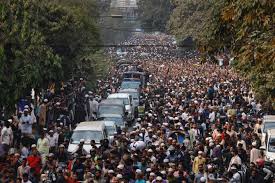
DHAKA, Bangladesh — Hundreds of thousands of people attended the funeral Saturday of prominent Bangladeshi activist Sharif Osman Hadi, who died from gunshot wounds sustained earlier this month in Dhaka, as political tensions escalate ahead of the country’s upcoming elections.

Hadi, a key participant in last year’s political uprising that ended former Prime Minister Sheikh Hasina’s 15-year rule, died Thursday in a Singapore hospital after being shot on December 12 in Dhaka.Police have identified suspects and indicated that the shooter likely fled to India, where Hasina has been living in exile. The incident sparked a diplomatic dispute, with New Delhi summoning Bangladesh’s envoy, and Dhaka responding by summoning the Indian envoy.
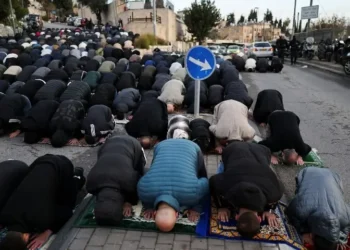
Security was tight in Dhaka during the funeral prayers held outside the Parliament complex. Hadi’s body arrived Friday night, and the day was declared one of national mourning. He was a spokesperson for the Inqilab Moncho cultural group and is to be buried at Dhaka University next to the national poet Kazi Nazrul Islam.
Mourners waved Bangladesh flags and chanted slogans such as “We will be Hadi, we will be fighting decades after decades” and “We will not let Hadi’s blood go in vain.” Hadi’s death on Thursday evening triggered violence, with protesters attacking and torching offices of two leading national newspapers.
Interim leader and Nobel Peace Prize laureate Muhammad Yunus urged calm. Hadi was a vocal critic of both neighboring India and Hasina. He had planned to run as an independent candidate in a major Dhaka constituency in the February elections.
Bangladesh is currently navigating a critical democratic transition under Yunus, with the upcoming polls seen as a path toward stability. The political landscape remains dominated by Hasina’s Awami League party and her rival, former Prime Minister Khaleda Zia’s Bangladesh Nationalist Party, which hopes to form the next government. Meanwhile, the Jamaat-e-Islami party, Bangladesh’s largest Islamist party with historical ties to the 1971 independence war, is seeking to expand its influence amid Hasina’s absence.
Hasina has been sentenced to death for crimes against humanity, but India has not responded to repeated requests from the Yunus-led government for her extradition.