












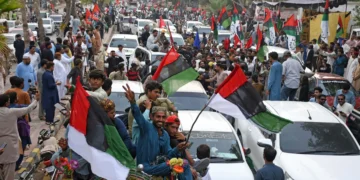
















































DHAKA (MNN); The Bangladesh Nationalist Party (BNP) was projected to form the next government as Bangladesh held its first general election on Thursday since mass protests in 2024 forced former prime minister Sheikh Hasina from power.

The vote, largely peaceful, was widely seen as a crucial test of the country’s democratic process after years of political unrest, culminating in the so-called Generation Z uprising that led to Hasina’s exile in India.
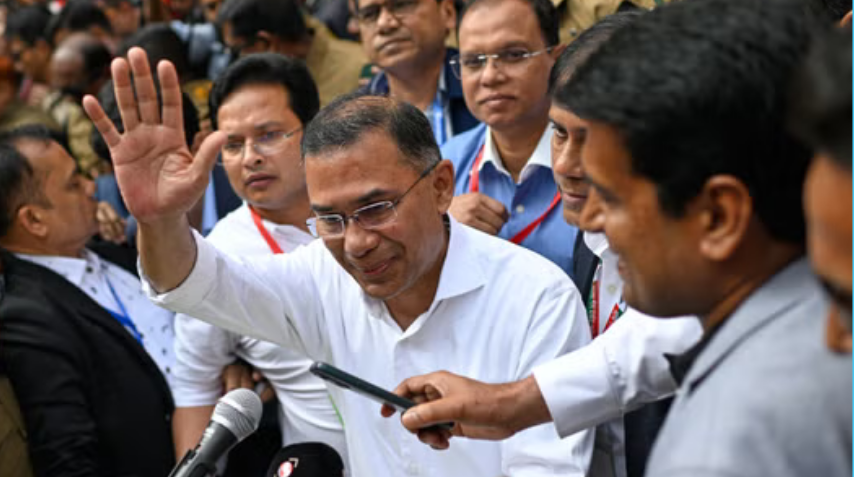
While official results were expected on Friday, early projections cited by Dhaka-based Jamuna TV showed the BNP leading with 151 seats — enough to secure a parliamentary majority and form a government. The outcome could pave the way for BNP leader Tarique Rahman to assume national leadership.
Rahman, who returned to Bangladesh in December after 17 years in self-imposed exile in London, is the son of former prime minister Khaleda Zia, who passed away in December.
The BNP’s main rival, an 11-party alliance led by the Islamist Jamaat-e-Islami, was projected to win 40 seats, with three others going to smaller parties.
Bangladesh’s 300-member parliament is elected through direct voting, with an additional 50 seats reserved for women.
Voter turnout gained momentum after a slow start, with more than 47 percent of voters casting ballots by 2 p.m., according to the Election Commission. Over 127 million people were eligible to vote. Security remained tight, and political party representatives monitored polling stations.
Hasina’s Awami League, barred from contesting the election, rejected the process. In a statement, the party described the vote as illegitimate and accused interim leader Muhammad Yunus of orchestrating a flawed election without the participation of the Awami League.
Yunus, a Nobel Peace Prize laureate heading the interim government, said the polls marked “the birthday of a new Bangladesh” and pledged transparency. Around 500 international observers and foreign journalists, including delegations from the European Union and the Commonwealth, monitored the vote.
The election follows a turbulent period marked by unrest, attacks on minorities and media, and concerns over the growing influence of Islamist groups. Bangladesh’s political history since independence in 1971 has been shaped by rivalry between major parties, military interventions and allegations of electoral manipulation.
Young voters, many of whom played a prominent role in the 2024 protests, were expected to influence the outcome. Approximately five million citizens were casting ballots for the first time.
Alongside electing lawmakers, voters were also asked to endorse key reform proposals through a referendum linked to a national charter signed last year by major parties. If approved, parliament could establish a constitutional reform council to implement changes within 180 working days, including the creation of new constitutional bodies and transitioning to a bicameral legislature.
Both the BNP and Jamaat-e-Islami signed the reform document with amendments, while the Awami League was excluded from the process and criticized the referendum from exile.