











































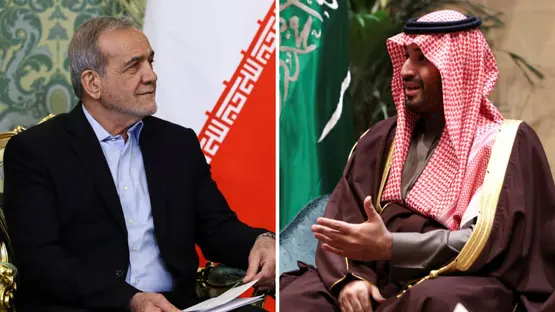
Web Desk (MNN); Iranian President Masoud Pezeshkian held a phone call with Saudi Crown Prince Mohammed bin Salman on Tuesday, following the arrival of a US aircraft carrier in the region amid growing fears of a potential conflict involving Iran, Israel, or the United States.

The United States has recently hinted at possible military action against Iran in response to Tehran’s deadly crackdown on protesters, which left thousands dead. In response, US President Donald Trump dispatched the USS Abraham Lincoln aircraft carrier to the Middle East.
During the call, President Pezeshkian condemned US “threats,” describing them as attempts to destabilize the region that would only lead to insecurity and instability. He emphasized that external pressures, including economic sanctions, had failed to weaken the resilience and awareness of the Iranian people, according to an official statement.
Saudi Crown Prince Mohammed welcomed the dialogue, reaffirming Saudi Arabia’s commitment to regional stability, security, and development. He stressed the importance of solidarity among Islamic nations and rejected any aggression or escalation against Iran. He also expressed Riyadh’s readiness to foster peace and security throughout the region.
The phone call comes amid escalating tensions following repeated US threats to attack Iran during the recent anti-government protests. Last week, President Trump sent a naval armada toward Iran but expressed hope that military action would not be necessary.
Meanwhile, Iran’s Islamic Revolutionary Guard Corps (IRGC) issued a warning to neighboring countries. Mohammad Akbarzadeh, political deputy of the IRGC naval forces, stated that while neighboring nations are considered friends, any use of their territory, airspace, or waters against Iran would be treated as hostile.
The heightened tension follows last year’s Israeli attacks on Iran targeting military officials, nuclear scientists, and nuclear facilities, in which the US joined the operation to bombard three nuclear sites. Negotiations over Iran’s nuclear program have yet to resume, with the US continuing to demand Iran halt uranium enrichment.
A US official said Washington is “open for business” with Iran, but experts like Ali Vaez of the International Crisis Group suggest the likelihood of Iran agreeing to US demands is “near zero,” emphasizing that compromise under pressure only invites further demands.
Iran’s Foreign Ministry spokesperson, Esmaeil Baghaei, warned that any strike on Iran would have repercussions across the region. “Regional countries fully know that any security breach in the region will not affect Iran only. The lack of security is contagious,” he said.
The situation underscores rising volatility in the Middle East, with both diplomatic and military maneuvers shaping a tense and unpredictable environment.