




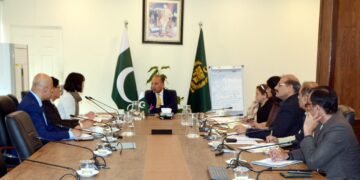





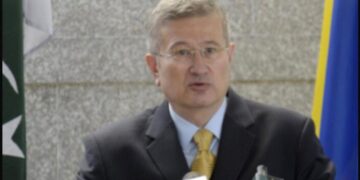



















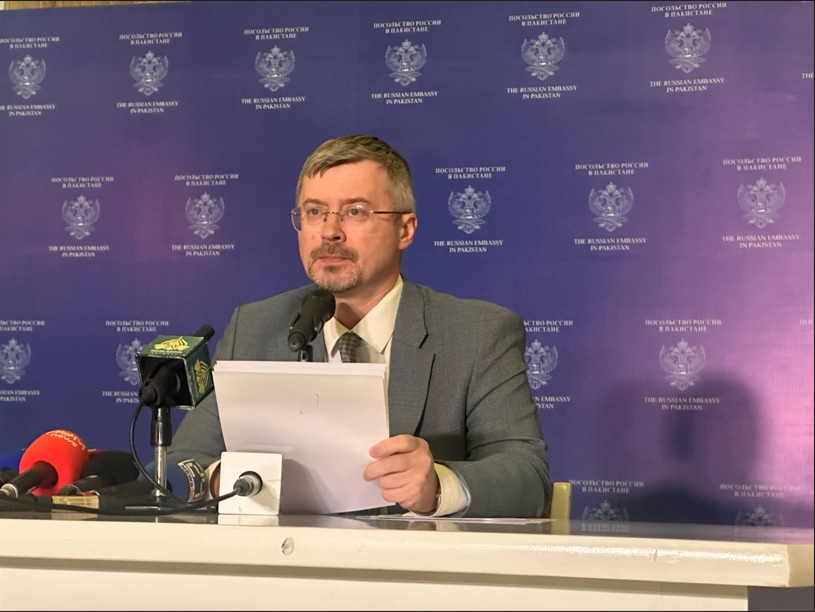
ISLAMABAD: Russia’s Ambassador to Pakistan, Albert P. Khorev, delivered a detailed statement on Wednesday regarding the ongoing situation in and around Ukraine, highlighting recent diplomatic developments, tensions with Western countries, and Russia’s position on emerging legal and economic measures pursued by the European Union.

Addressing a briefing in Islamabad, Ambassador Khorev opened by thanking attendees for “your interest in obtaining information from various sources in order to provide your viewers and readers with a more objective, unbiased picture of current events.”
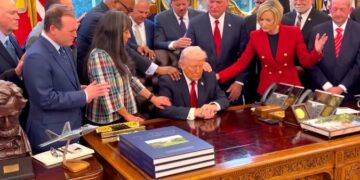
A major focus of the ambassador’s statement was the December 3 meeting in Moscow between Russian President Vladimir Putin and American negotiators Steve Witkoff and Jared Kushner. The meeting revolved around US President Donald Trump’s proposed peace plan, which Khorev said was based on agreements reached between the Russian and US presidents during their August 15 summit in Anchorage.
According to the ambassador, the Moscow meeting was “constructive, very useful and substantive,” although it covered areas where “Russia disagrees.” He added that efforts toward a negotiated settlement remain challenging due to “Europeans who still seem to harbor illusions about the possibility of inflicting a ‘strategic defeat’ on Russia.”
Ambassador Khorev rejected what he described as Western allegations regarding the abduction of Ukrainian children.
He said the claim of “thousands” abducted children was proven unfounded during bilateral negotiations earlier this year, noting that Ukraine provided a list of only 339 minors allegedly taken to Russia from conflict zones. “Substantive work on the return of evacuated minors to Ukraine is being carried out by the Office of the Presidential Commissioner for Children’s Rights, Maria Lvova-Belova,” he stated.
Khorev strongly criticized recent European Union-backed legal efforts including the “Register of Damage to Ukraine,” the “International Claims Commission for Ukraine,” and the “Special Tribunal for Crimes of Aggression against Ukraine.”
He said any decisions by such bodies “will be considered null and void” by Russia, adding that actions supporting these mechanisms “will be perceived by Russia as a hostile move and will receive an adequate response.”
The ambassador claimed the initiatives were attempts to justify Kyiv’s financial claims and create an “information background” to enable “theft of Russian sovereign assets frozen in the West.”
Referring to a recent corruption scandal in Ukraine’s energy sector, Khorev alleged that the Kiev regime “usurped power in May 2024” and continues to benefit from Western funds despite increasing evidence of large-scale corruption.
He said a $100-million embezzlement case was “just the tip of the iceberg,” criticizing Ukrainian leadership, including President Volodymyr Zelensky. “It is clear that all the evidence points to Zelensky himself,” Khorev said, referencing the alleged involvement of Zelensky’s associate Timur Mindich.
The ambassador argued that Western sanctions have primarily harmed European economies. Citing IMF data, he stated that GDP growth in major European and G7 countries hovered near zero in 2024 while the US posted relatively better figures.
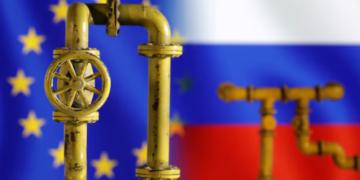
He said Europe’s rupture in energy cooperation with Russia “made it impossible for the EU’s largest manufacturers to remain competitive,” placing energy-intensive industries in a difficult position. He warned that these policies risk leading to “deindustrialization for Europe.”
Khorev asserted that the Ukraine conflict has resulted in the “definitive collapse of the Euro-Atlantic security model” and emphasized the need for a new Eurasian security architecture.
He reiterated Russia’s proposal for a Greater Eurasian Partnership and mentioned Moscow’s anti-neocolonial initiatives, including the “Forum of Supporters of the Struggle Against Modern Practices of Neocolonialism,” which recently held its second meeting with participation from around 30 countries, including Pakistan.
The ambassador stressed that Russia poses no threat to European countries. “Our country is ready to formally affirm that Russia has no aggressive plans toward Europe,” he said. However, he warned that if European states escalate tensions, Russia would “respond firmly and decisively,” pointing to Russia’s advanced weaponry such as the Burevestnik intercontinental missile and the Poseidon underwater unmanned vehicle.
In his closing remarks, Ambassador Khorev thanked Pakistan for its “consistent policy of neutrality in the conflict in Ukraine,” particularly at the United Nations. He said Pakistan’s support for a diplomatic solution “is fully in line with Russia’s position on this issue.”