






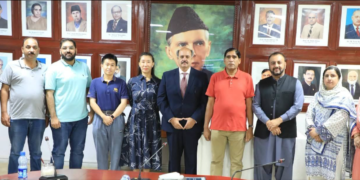


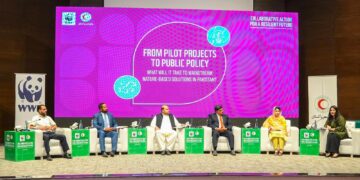






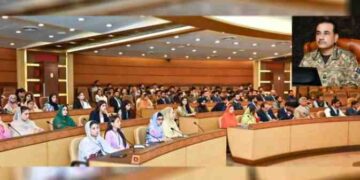















































Rawalpindi: The role of young people in strengthening inclusive governance and public decision-making was highlighted during a public dialogue held at Pir Mehr Ali Shah Arid Agriculture University (PMAS-AAUR). The event brought together a large number of students, faculty members, senior representatives of government institutions, and civil society leaders.

The dialogue focused on how youth can move from being passive observers to active contributors in governance. Discussions centred on inclusive decision-making, integrity in public service, digital participation, and citizen-centred governance, while providing a platform for direct interaction between young people and public officials.
Delivering the keynote address, Mukhtar Ahmad Ali, Executive Director of the Centre for Peace and Development Initiatives (CPDI), said that inclusive governance lies at the heart of democracy and that youth have historically played a decisive role in Pakistan’s political development. Referring to the Pakistan Movement, he said youth mobilisation was instrumental in the struggle for independence and that constitutional principles such as participation, equality, federalism, and fundamental rights continue to define democratic governance. He warned that growing disillusionment among young people could lead to disengagement and brain drain, stressing the need to restore public trust through democratic reforms, accountability, and adherence to constitutional values.
The panel discussion was moderated by Mumtaz Mughal, Gender and Inclusion Expert and Director at the Aurat Foundation, and featured senior officials from federal, provincial, and local government institutions along with representatives from civil society.
Qaiser Mehmood, Divisional Coordinator at the Punjab Commission on the Status of Women, highlighted Punjab’s progress towards gender-responsive governance. He referred to initiatives including the Gender Parity Report, women-led district administrations, women police officers, gender cells in police stations, women helplines, virtual police stations, and regulatory reforms such as stricter controls on acid sales. He said inclusive governance requires shared responsibility between the state and citizens.
Speaking from a disaster management perspective, Bushra Hassaan Chaudary, Director Finance/ERRA Cell at the National Disaster Management Authority (NDMA), discussed the evolving role of youth in disaster preparedness and response. She said that since the 2005 earthquake, Pakistan has shifted from a reactive to a proactive disaster management approach, with emphasis on early warning systems, scientific forecasting, and community-based preparedness. Youth volunteers and interns, she added, often serve as first responders during emergencies.
Addressing digital participation and civic engagement, Sadaf Khan, co-founder of Media Matters for Democracy, pointed to persistent gaps in digital access, particularly for women and marginalised communities. She cautioned that algorithm-driven platforms often reinforce polarisation and misinformation, underscoring the need for digital literacy, critical thinking, and responsible online engagement among young people. She said rebuilding trust between citizens and the state requires transparency and credible communication.
Representing the local administration, Rabia Aurangzeb, Additional Commissioner and Director at the ICT Administration, emphasised the importance of inclusive governance at city and district levels, describing youth engagement as a key element of responsive public service delivery.
Aliya Razak, Director Inclusion at the National Database and Registration Authority (NADRA), shared insights into initiatives aimed at improving access to legal identity for marginalised populations. She highlighted NADRA’s efforts to strengthen inclusion and announced opportunities for youth engagement through outreach and facilitation mechanisms to expand identity registration services.
An interactive question-and-answer session followed, during which students raised concerns related to youth participation in emergency response, access to scholarships for women, digital inclusion, and rising intolerance. Panelists encouraged young people to engage thoughtfully with public issues, strengthen media literacy, listen across differences, and recognise their individual responsibility in shaping democratic culture.
The dialogue was organised by Accountability Lab under the Integrity Innovation Lab, an initiative that works with youth, civil servants, and institutions to promote ethical, inclusive, and citizen-centred governance through dialogue, innovation, and evidence-based engagement.
In his closing remarks, Dr Javed Asad, Director Quality Enhancement Cell at PMAS-AAUR, said that individual actions matter, particularly in an era shaped by artificial intelligence and digital technologies. He urged students to critically assess both the opportunities and risks of emerging technologies and to take ownership of their role in strengthening inclusive and democratic governance.