










































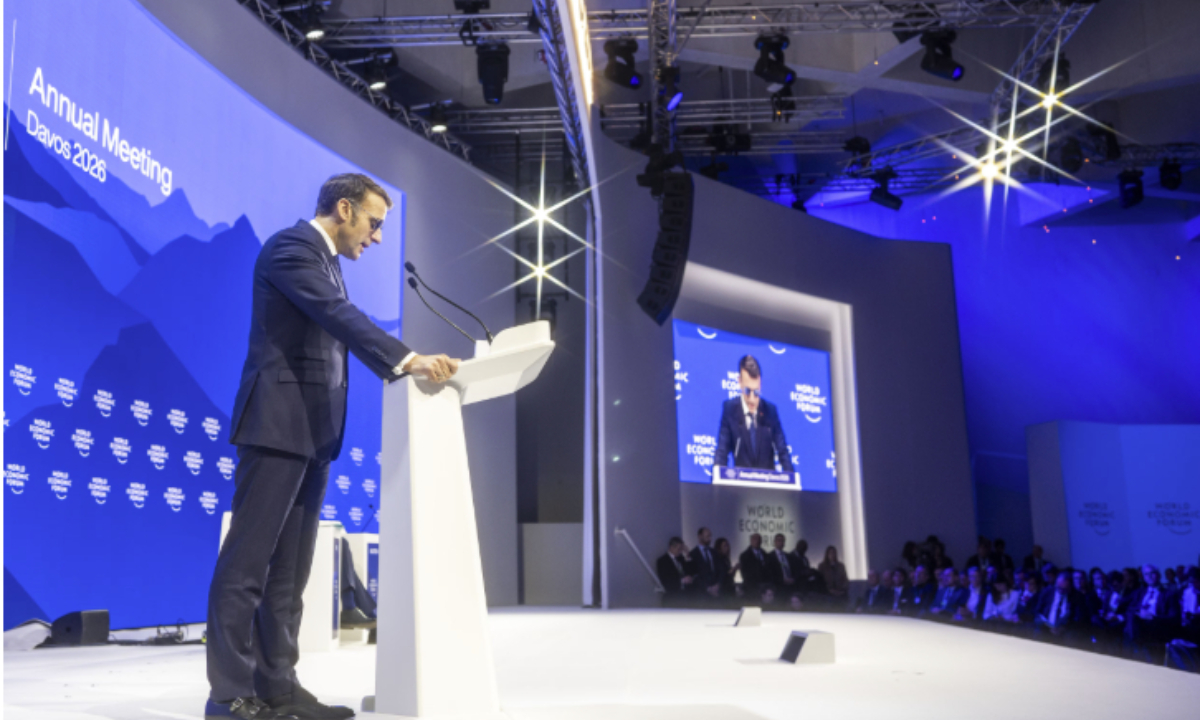
(Global Times): French President Emmanuel Macron has called for more Chinese foreign direct investments (FDIs) in “some key sectors” in Europe, during an address at the World Economic Forum (WEF) Annual Meeting 2026 in Davos, Switzerland. This reflects the EU’s attempt to rebalance economic ties with China amid a slew of challenges, including rising tension with the US, but Brussels must fundamentally shift its approach toward China by demonstrating greater sincerity and pragmatism, a Chinese expert said.

In his speech, Macron addressed a series of issues the world and Europe face, including what he claims as “competition” from the US and China, according to a transcript posted on the WEF’s website.“China is welcome, but what we need is more Chinese foreign direct investments in Europe, in some key sectors, to contribute to our growth, to transfer some technologies, and not just to export towards Europe, some devices or products which sometimes don’t have the same standards, or are much more subsidized, than the ones being produced in Europe,” Macron said.
Jian Junbo, director of the Center for China-Europe Relations at Fudan University’s Institute of International Studies, told the Global Times on Wednesday that “this stance on China is not something new, or an immediate action responding to US’ recent tariff threat over Greenland. It in fact shows that the EU – as a whole – has been trying to rebalance its China approach in face of rising protectionism as well as the US’ hegemonic moves.”
In the speech, Macron also claimed that in the competition from China, where massive excess capacities and distortive practices threaten to overwhelm entire industrial and commercial sectors. “And the answer, in order to fix this issue, is more cooperation. And building new approaches,” he said. This is also in line with what Macron wrote in the Financial Times after his visit to China at the end of last year.
In an article published on the Financial Times titled “We urgently need to rebalance EU-China relations,” Macron said that “placing tariffs and quotas on Chinese imports would be an uncooperative answer” and pointed out that “rebalancing foreign direct investment flows is essential.”
“From the Chinese perspective, there are no fundamental obstacles to expanding investment in Europe; it aligns with the direction of mutually beneficial cooperation, and Chinese enterprises are indeed interested in seeking new development opportunities in the European market,” Jian said, stressing that the EU needs to demonstrate greater sincerity by eliminating obstacles currently in place for Chinese investment.
Notably, in his speech in Davos, Macron sharply criticized the US on tariffs and other issues. “Competition from the United States of America through trade agreements that undermine our export interests, demand maximum concessions and openly aim to weaken and subordinate Europe, combined with an endless accumulation of new tariffs that are fundamentally unacceptable – even more so when they are used as leverage against territorial sovereignty,” he said.
The comment was made as the EU and the US have been embroiled in an escalating tension and a potential trade war over the Greenland issue after the US announced tariffs against eight European countries.
Macron has said that the EU could retaliate by deploying one of its most powerful economic tools, known colloquially as a trade “bazooka,” according to a report by the Associated Press.“Europe has very strong tools now, and we have to use them when we are not respected, and when the rules of the game are not respected, by the way,” Macron said in the speech. “But we do prefer respect to bullies. We do prefer science to plotism, and we do prefer rule of law to brutality.”
In the face of the increasingly intensified US trade protectionism and rising geopolitical tensions, both Europe and China are confronted with common challenges and there is plenty of room for deepening cooperation, analysts said. However, Jian pointed out that it is essential for the EU to fundamentally shift its approach toward China by demonstrating greater sincerity and pragmatism, rather than merely viewing China through the lens of EU-US tension.
More importantly, Brussels should abandon its so-called “de-risking” strategy toward China and adopt a more objective and pragmatic perspective view on China and focus on long-term cooperation between the two sides, Jian said, adding that this would significantly encourage greater Chinese investment in Europe.